
QUICK SUMMARY
- Fantasy football users were mostly passive since the majority built their team once and never adjusted it. But they still opened the app regularly, making them valuable for retention-driven business models.
- A single goal by a marquee player triggered 10x+ simultaneous traffic spikes. If your architecture can't handle that in sub-second response time, users lose trust.
- Draft mode is the hardest engineering problem - because real-time state synchronization across 8–12 users with 60-second pick timers and shared player pools is far more complex than budget-based team selection.
- Generating one personalized email required computing the full state of a user's account. Multiply that by every subscriber, and you have a serious backend challenge.
- The football calendar is your release calendar. Build features Feb–Apr, test over summer, feature-freeze by August. Shipping during match days is how platforms go down.
Introduction
There's a specific kind of stress that only developers of live sports applications truly understand. It's when a striker scores in the 98th minute of a match between two of the league's biggest clubs, and in that single heartbeat, hundreds of thousands of people simultaneously open your app to see if their fantasy team just gained or lost some critical points.
That's the reality I lived with for multiple seasons working on a biggest football fantasy app development projects built around the English Premier League in the EU. Due to confidentiality agreements, I can't name the client. But I can tell you that at its peak, the platform attracted between 900,000 active users in a single season. And every single season, the same question hung over our August launch: will we survive?
Across the fantasy sports app development industry, the ability to handle sudden, massive traffic surges during live match events remains one of the most cited technical challenges teams face. What made our situation particularly intense was the predictability of the unpredictability. We knew the spikes were coming, but their exact magnitude was impossible to forecast.
What Kind of Fantasy Football We Were Building
Before diving into the war stories, let me tell you what a successful fantasy football platform demands from a technical team. Our fantasy sports app was a multi-mode, real-time sports platform with live data dependencies, personalization at scale, and a user base that behaved in ways that consistently surprised us.
Season Mode
The main seasonal mode was the heart of the platform. Players received a virtual budget of 50 million to assemble their dream team from real Premier League footballers. Throughout a season spanning roughly September to May, it is about 30 gameweeks, users could trade players, react to injuries, and make strategic decisions during transfer windows. Competition happened at two levels:
- Private Leagues
In private leagues friends went head-to-head, and a global leaderboard with real prizes at stake. - Celebrity-created Leagues
They were also part of the mix, tied to sponsorship deals that added a layer of business complexity on top of the technical ones.
One feature that added both revenue and complexity was betting integration. We received odds data from betting providers and displayed their advertisements within the app. This kind of integration is increasingly common in fantasy sports app development today. Sports betting partnerships have become a standard monetization layer, though it also introduces regulatory considerations that teams need to plan for early in the development process.
Weekly Mode
The second mode ran on a weekly cycle and was frequently reconfigured for special tournaments, most notably the World Cup. For these events, we had to parse incoming data differently, implement tournament-specific game days, and adapt the core logic to handle playoff formats. The underlying mechanics were similar to the seasonal mode, but the timeline compression made everything more urgent.
Draft Mode
Draft Mode was our most technically interesting challenge and, ironically, the least-used feature. Instead of a budget-based team selection, league participants typically 8 to 12 teams gathered and took sequential turns picking players from a shared pool. Each pick had a 60-second timer, with an autopick system as a fallback.
After the draft, each team consisted of 10 starting players and 4 bench players. Injured or suspended players could be swapped in from the bench, with one hard rule: only goalkeepers could play in goal. Managing the real-time state of a live draft across multiple simultaneous users was one of the more genuinely tricky engineering problems we solved.
Draft mechanics like timed selections, shared player pools, real-time state synchronization represent some of the more complex interaction patterns in fantasy sports. Getting the user experience right here requires careful attention because even a second or two of delay during a draft pick can feel like an eternity to the user whose turn it is.
Your next read: Top 8 Fantasy Sports App Development Companies
What We Learnt From Users
If there's one section of this story that every product developer should read, it's this one. Because the way our users actually behaved was fundamentally different from what you might expect. Understanding that gap was critical to every infrastructure decision we made.
Most Users Were Watchers, Not Managers
The vast majority of users created their team at the start of the season and then essentially watched it play out. They didn't log in to tinker. They didn't make weekly adjustments. They built their squad once, with care and optimism, and then checked in sporadically to see how things were going.
Peak activity concentrated the weeks before the first gameweek, when people were optimizing their initial selections. After that, engagement dropped off significantly and stayed low through most of the season. By May, the app was like a ghost town.
This pattern might seem discouraging from a product perspective, but it actually revealed something important about the platform's real value.
Even "passive" users who check in infrequently generate meaningful engagement signals. They open the app, they see related content, they stay in the ecosystem. For a platform whose primary goal was audience retention for a news outlet, this type of engagement was exactly the point.
Goals Were the Real Traffic Events
When a goal was scored in a match featuring a top-tier club, thousands of users opened the app simultaneously. Not later. Not after the match. Right then, at that moment, to see whether their fantasy points had updated.
Goals and draws created the most intense server load of any event in the entire season. Since so many users had popular players on their teams, a single goal by a marquee player could trigger a massive, simultaneous spike in requests.
This pattern is well-documented across the industry. Fantasy sports mobile app developers routinely plan for traffic spikes of 10x or more during live match events compared to baseline. Understanding when the spike will happen and at what intensity is what separates platforms that survive from those that crash at exactly the wrong moment.
The Technical Challenges of Fantasy Football App Development
Real-time Data
Everything in a fantasy football app depends on live match data. Player scores, injury updates, substitutions, cards — all of it needs to flow into the system accurately and quickly. A delay between a real-world event and its reflection in the app undermines trust in the platform's fairness.
In practice, this typically means integrating with third-party sports data providers — companies like Sportradar or Opta that supply live match feeds. The challenge was more about processing it fast enough and with enough reliability that your scoring engine stays in sync with what's actually happening on the pitch. We learned this the hard way more than once.
Modern approaches to this problem often involve WebSocket connections for maintaining open, real-time channels between the server and the client, combined with caching layers like Redis to reduce database load during peak moments. The goal is sub-second updates during live matches, anything slower and you start losing users' confidence.
Personalized Email Challenge
One of the features I remember most vividly was the Fantasy Coach premium subscription. It was an annual product that gave users access to an expanded analytics dashboard. Part of that subscription was an automated email system that, in theory, was straightforward: send subscribers a personalized summary of their performance.
In practice, it was one of the most complex features I built. Each email required calculating the entire state of all users’ accounts. Personalized analytics, performance breakdowns, team recommendations based on their specific roster — generating a single email meant running a significant computation. And we had to do it for every subscriber.
This kind of personalization challenge is becoming increasingly common for custom fantasy sports app developers. As apps move toward AI-driven recommendations and hyper-personalized content feeds, the backend computation required to generate that personalization scales with the user base in ways that teams often underestimate early in development.
Season Calendar as a Development Framework
The football calendar was our development calendar. New features were built between February and April, when the season was winding down and traffic was low. May and June were for preparation and integration. Testing ran through the summer. By August, when the new season launched and users flooded back, we were frozen on features and focused entirely on stability.
This approach is a pattern that resonates strongly with how high-traffic platforms across industries handle release cycles. In fantasy league app development, where a single bad deployment during a match day can affect hundreds of thousands of users simultaneously, the discipline to not ship during critical windows is about stability and user care.
Why This Story Matters Now
The fantasy sports market is growing fast, projections place the global industry at over $56 billion by 2030, with consistent double-digit annual growth. More businesses are entering this space, and the technical bar for doing it well is higher than ever. If you're evaluating the investment, take a look at the breakdown of what fantasy sports app development costs.
Real-time data integration, scalability under pressure, personalization at scale, and multi-mode complexity are the day-to-day reality of building and maintaining a fantasy sports platform.
There were nights of stress, incidents that taught us uncomfortable lessons, and features that didn't work the way we'd hoped. But it served nearly a million users through multiple full seasons and it survived every single one of those great August launches.
That, in the end, is what building a fantasy sports app development comes down to. Preparedness that users trust and enjoy.
What We're Building Now At Uinno
I've been with Uinno for almost five years now, and the lessons from that Fantasy Football App project like the traffic spikes, the real-time scoring pressure, the multi-mode complexity have directly shaped how we approach fantasy sports development today. Here's what that looks like in practice:
- PuntClub: Multi-sport Tipping Across 400 Australian Pubs
A pub-based tipping platform that covers AFL, NRL, and horse racing. Within 1.5 month we built an MVP, and later on worked on the entire platform that processes multiple live sports feeds simultaneously. - Product Discovery for Fantasy Tennis App
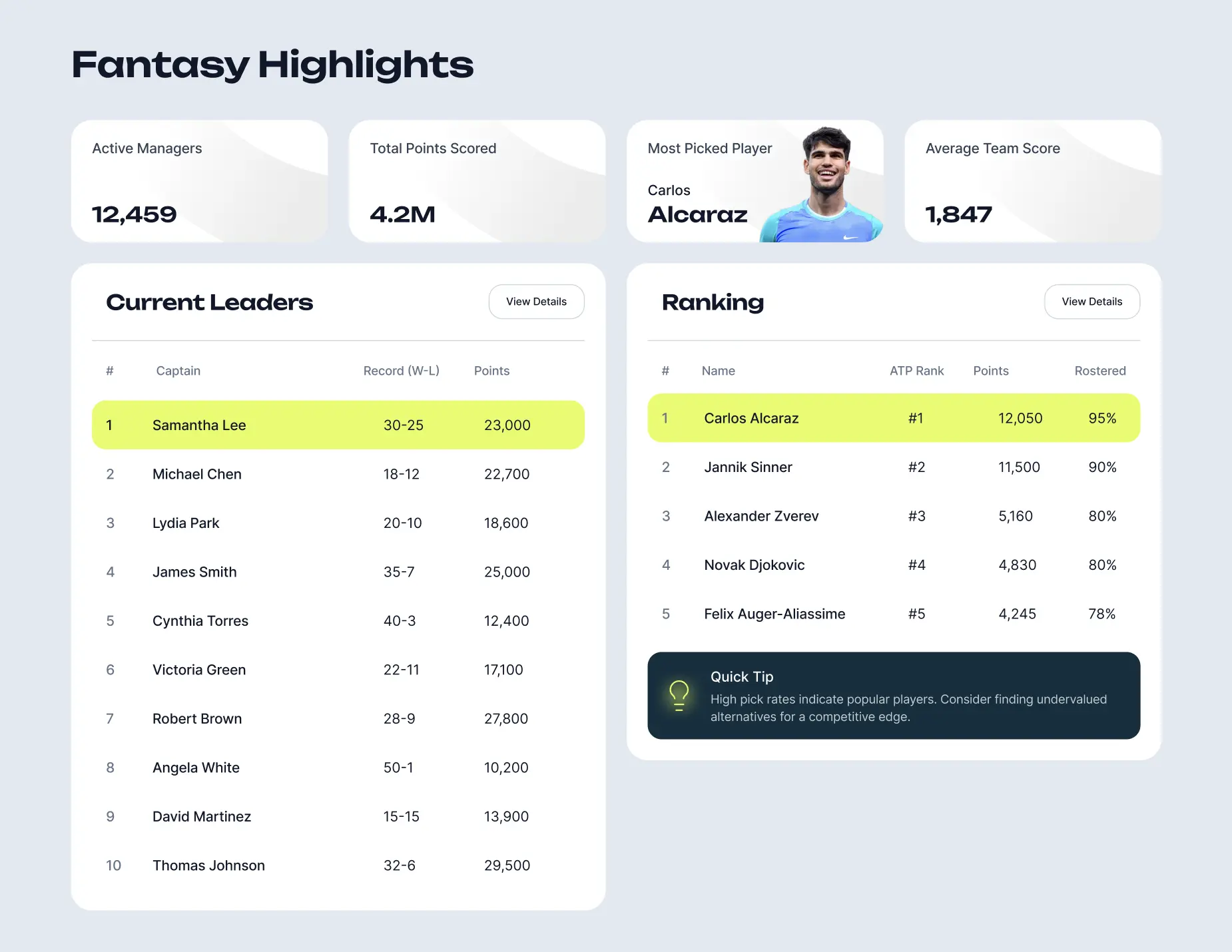
We did a product discovery for a year-round fantasy tennis platform. This covered market and competitor analysis, product positioning, and engagement mechanics tailored specifically to tennis. The discovery phase service resulted in a complete product blueprint, that includes league mechanics, player risk indicators, clickable Figma prototype, along with a clearly defined MVP scope and phased roadmap. On the technical and business side, we delivered cost estimation, scalable system architecture, and investor-ready documentation, enabling fast validation, fundraising, and a smooth transition into development.
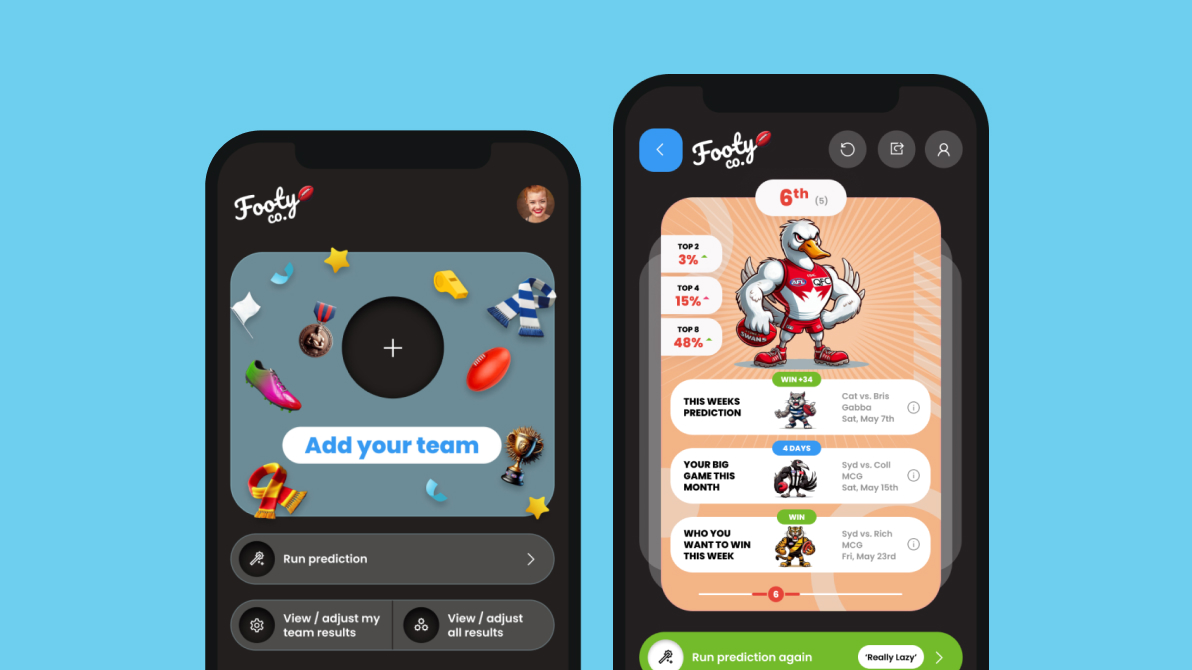
- Ladder Predictor That Makes AFL Predictions in 2-3 seconds
Cross-platform web & mobile apps that processes 250 matches instantly using complex mathematical models. Stadium conditions, team history, rest periods and hundreds of variables are distilled into fast, accurate predictions. Real-time AFL API integration with probability calculations for Top 2/4/8 finishes. - Unique Fantasy Rugby Fantasy App for News Media Outlet
Rugby's automatic substitution logic is deceptively hard: bench players score if on-field players underperform, but only if they meet position eligibility, minimum game time, and "actually played" criteria. Web and mobile apps currently serve around 250k users during peak seasons.
I like to think about fantasy sports apps like personalities. Each one has its own market fit, its own goals, its own quirks. What worked for a Premier League season-long platform wouldn't work for pub-based AFL tipping. What makes tennis fantasy engaging is completely different from rugby's bench mechanics. And honestly, I feel incredibly fortunate to work with colleagues and managers who genuinely care about the quality and performance of what we build. That's the kind of team that keeps platforms alive when it matters.
Your next read: How to Build a Fantasy Rugby App
.png)
.png)