
QUICK SUMMARY
- Building an MVP in 2026 has never been cheaper to start and never been harder to get right. AI tools compress build time by 25 to 40%, but the wrong-product failure rate still sits at 42% because the product is only 20% of the work while the other 80% is figuring out the business.
- Cost splits into three tiers: no-code prototypes start at $1K and ship in 1 to 4 weeks, simple custom MVPs run $15K to $30K over 8 to 12 weeks, and AI-powered MVPs with data pipelines and model integration cost $15K to $50K+ across 16 to 24 weeks.
- Hidden costs catch most founders off guard. Server hosting, third-party APIs, ongoing maintenance, and post-launch iteration add 15 to 25% of the build cost every year on top of what you already spent.
- The single highest-ROI line item in any MVP budget is a $3K to $8K discovery sprint that prevents roughly $50K in rework. Teams that invest in pre-development planning are 3x more likely to ship a successful product.
- AI is a power tool, not a replacement for engineering. It handles the fast, low-risk 80% of building (prototypes, layouts, boilerplate), but the hard 20% that decides whether your product survives (security, business logic, compliance) still needs experienced humans who can catch what AI gets wrong.
- Define the problem before the solution, validate demand with real users before writing code, lock your scope ruthlessly, and start with the cupcake instead of the wedding cake.
1. What Is an MVP (and What It’s Not)
Eric Ries defined the concept in 2011. Fifteen years later, the definition still confuses many founders. An MVP is the smallest version of a product that delivers core value to real users and produces validated learning. Not a prototype, not a half-finished product, not something you’re ‘embarrassed by’ in the Reid Hoffman sense.
Prototype vs MVP vs Full Product
Founders use these three words interchangeably and lose money to the confusion. The PoC vs MVP distinction matters for budget, timeline, and what counts as a successful result. A proof of concept (PoC) tests if a specific idea works. A prototype tests if a design or flow makes sense. An MVP tests if users will use a product and pay for using it.
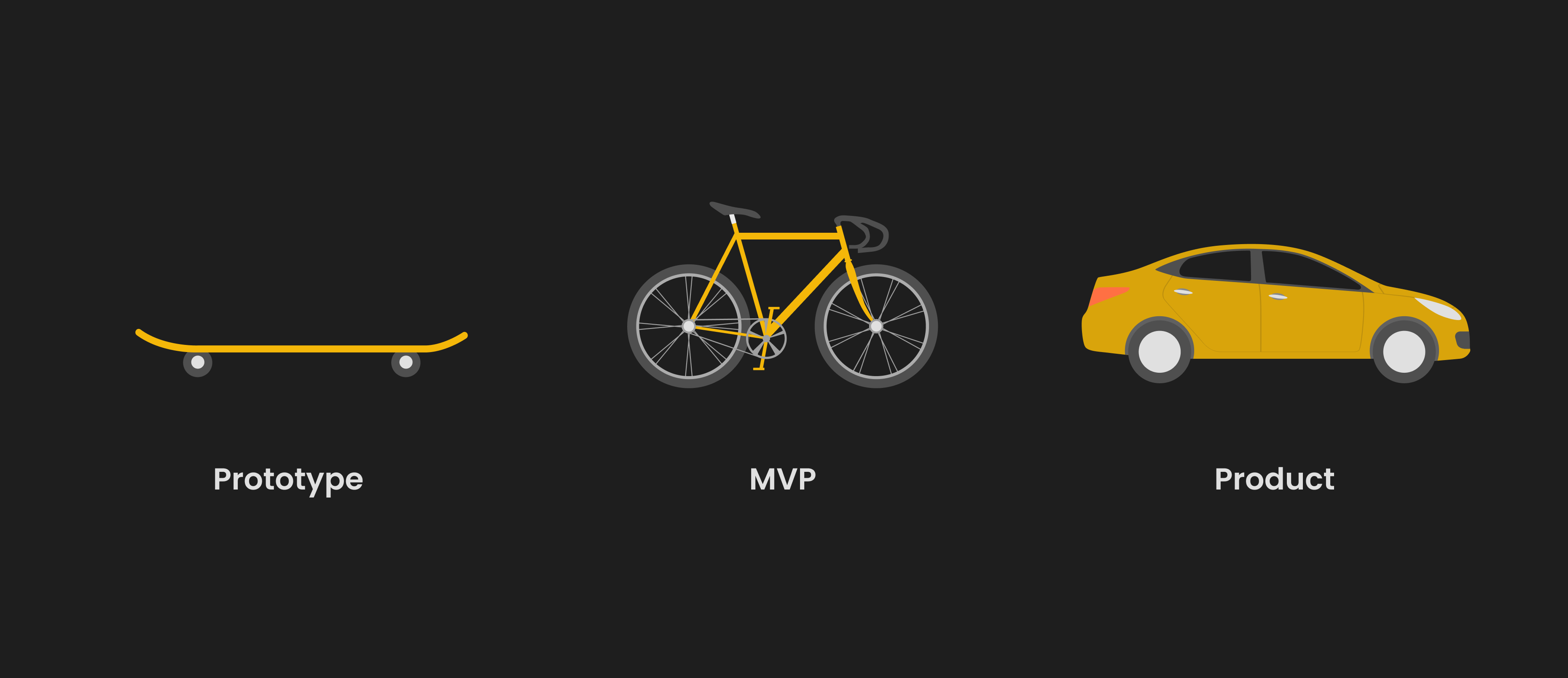
The table below maps the three stages across the decisions that matter: who sees it, what it costs, and what you walk away with.
Five Misconceptions Founders Bring to Their First MVP
- MVP means low quality. Wrong! It means minimum necessary scope. Quality on the core workflow should be non-negotiable.
- MVP is the first version that ships and you’re done. An MVP is the start of a Build-Measure-Learn loop. In fact, it’s the beginning of a business.
- You need all the features to get user feedback. You need the single feature that proves or disproves your core hypothesis.
- AI tools mean anyone can now build production software solo. They mean anyone can build a compelling prototype solo. Production software still requires engineering skills and expertise. If you don’t understand how things should work, you lose control over the product.
- A working MVP means product-market fit. Only 10–15% of MVPs achieve strong product-market fit without pivoting (Theanna, 2026). A working MVP means you have something worth iterating on.
Why Startups Must Build an MVP First
Skipping the MVP and going straight to a full product feels faster on day one and costs more by month six. Four reasons explain why MVP development for startups is the dominant approach in every YC batch and every credible startup playbook, and why the strongest MVP development services for startups all refuse to take a project that wants to skip this step.
Validate product-market fit before burning budget
McKinsey research on IT projects found that builds without proper validation run 45% over budget on average. The cost asymmetry matters: a $30K MVP that fails saves you the $300K full build that would have failed anyway, and gives you the data to decide what to build instead. Reaching product-market fit faster is the single biggest reason every credible MVP development process puts validation ahead of feature work.
Reduce development costs
A full product runs $150K and up. A startup MVP development project sits between $5K and $80K depending on type. Three levers control the cost: team size, no-code vs custom build, and feature count. It all comes down to scope discipline. Every feature you add at MVP stage adds 1–2 weeks of build time and a roughly proportional dollar amount, and most features do not change the validation outcome. Founders who treat MVP cost as “cheaper version of the full thing” overspend by 30–50% on average. Founders who treat it as “smallest possible learning instrument” spend exactly what they need to.
Attract investors with traction
Y Combinator’s 2025 numbers tell the story. Garry Tan disclosed that the W25 batch was the fastest-growing and most profitable cohort in YC’s history, partly because AI tools let teams ship and iterate faster. Crunchbase data shows seed deals declined 16% year-over-year while mega-rounds dominated, which means investors are concentrating capital on signals of demand. An MVP is the cheapest signal of demand you can produce.
Build a community of early adopters
Your first 50 users are worth more than your next 5,000. Early adopters tolerate rough edges, give concrete feedback, and tell you which features matter. They also become your first case studies, your first referrals, and the people who explain your product to other users when you cannot scale support. Skipping this and launching to “the world” produces silence and this is the worst possible input for a product team trying to find product-market fit.
How AI Is Changing MVP Development in 2026
Every founder needs to get one thing straight before they spend a dollar on AI MVP development. AI is fast and cheap for the easy 80% of building a product, and slow, expensive, or risky for the hard 20%. The trap is that the hard 20% is the part that decides whether your product survives once paying users get their hands on it.
Start with the good news, because it holds up. AI tools cut the build time on a standard product by 25 to 40%. They do not speed up the thinking part: figuring out who your user is, what to build, and how to stay on the right side of regulations. Add it up and a typical 12-week MVP finishes 2 to 4 weeks sooner. The proof that the speed is genuine: Lovable, the tool that lets you build an app by typing what you want in plain English, went from launch to $100M in annual revenue in eight months, and 100,000 new projects get built on it every day.
Now the part nobody tells you. Researchers at METR ran the cleanest study yet on AI coding tools. They took 16 experienced developers and gave them 246 tasks, half with AI and half without. The developers were sure the AI made them 24% faster. After they finished, they still felt 20% faster. The stopwatch said they were 19% slower. The reason: they spent more time fixing and cleaning up what the AI produced than they saved by having it write the first draft. The lesson for you is simple. The speed you feel from AI and the speed you get on the clock are two different numbers, and the gap is where MVP budgets quietly disappear.
So where does AI help, and where does it hurt? This is the map.
The numbers behind that last point are worth sitting with. When researchers reviewed code that AI helped write, it had 1.7 times more serious problems than code people wrote themselves. A survey of 18 senior engineering leaders found 16 of them had already lived through a disaster caused by AI-generated code, from sites crashing to user data getting corrupted. None of this means AI is bad. It means AI is a power tool, and power tools in untrained hands cut the wrong things.
The founder who uses AI best in 2026 is not the one who types the least. Lazar Jovanovic builds products for a living using these tools, for clients like Klarna and HubSpot, and he spends 80% of his time planning what to build and only 20% building it. He writes the AI a clear brief before he lets it touch anything, the same way you would brief a contractor before they pick up a hammer. His rule is the one that matters for your MVP: the clearer your instructions, the better the output. Hand the AI a vague idea and it will confidently build the wrong thing very fast.
The startups in Y Combinator’s 2025 batch that built 95% of their product with AI were all run by founders who could read code and catch the AI’s mistakes. If you cannot do that yourself, AI does not replace an engineer, it raises the stakes of not having one. Uinno’s AI product development practice draws the line in exactly this place: let AI handle the fast, low-risk 80%, and put experienced people on the 20% that can sink the product.
The MVP Development Process: 9 Steps from Idea to Launch
Most of the MVPs we have shipped at Uinno moved from scoping to a working product in roughly 8 to 12 weeks, though the range is wide and every project carries its own constraints. The sequence below is how we tend to think about how to build an MVP without wasting runway, and it is the order we keep coming back to, because the projects that run into trouble usually skipped or rushed one of the early steps. We are not claiming a guaranteed timeline or a formula that removes risk. We are describing the order of work that tends to keep a budget under control and a team pointed at the right problem.
Step 1: Define the problem, not the solution
A problem statement we find useful takes the shape: [user type] struggles with [problem] when [context]. If those three slots are hard to fill in concretely, the idea is probably still a feature in search of a problem rather than a problem worth solving. This is the cheapest place to catch that. Reworking a fuzzy problem definition costs a conversation; reworking it after a build has started costs weeks. We spend the first part of any engagement here, with the founder, before anyone scopes a feature.
Here are a few examples from the projects we worked on. See how that changes the focus?
Anti-fraud / identity verification (NDA platform)
Bad: “We need an AI-powered identity verification system.” (That’s a solution, not a problem.)
Good: “Platform moderators struggle to confirm a new creator is a real, of-age, consenting person when sign-up volume spikes and manual review can’t keep up.”
Fintech / prediction markets
Bad: “Build a trading dashboard with real-time charts.” (Jumps straight to features.)
Good: “Retail traders struggle to act on a market view fast enough when settling a position requires three tools and a manual payout step.”
AI product (agentic platform)
Bad: “Make an AI assistant that automates the workflow.” (“The workflow” is undefined.)
Good: “Solo consultants struggle to keep up with [specific recurring task] because it eats two hours a day and they can’t justify hiring for it yet.”
eLearning / edutech
Bad: “We want a gamified learning app with streaks and badges.” (Lists mechanics before establishing a problem.)
Good: “Self-taught learners struggle to stay consistent past week two when nothing in their day reminds them to return and no one notices if they quit.”
Step 2: Conduct user research and validate demand
Talking to 10 to 15 prospective users before committing to a build surfaces things a brief never will. A landing page with a small amount of paid traffic, or a pre-order if the product allows it, tests whether interest converts into action rather than polite agreement. In interviews, the questions that tend to produce the most signal are the ones anchored in the past: walk me through the last time you faced this problem, what did you do about it, and what did that cost you in time, money, or frustration. Past behavior is a stronger predictor than a hypothetical “would you use this,” which people answer generously and act on rarely. We run this research with founders who want it, and we are happy to look at research a founder has already done and pressure-test it.
Step 3: Map the user journey and identify core flows
Before scoping features, it helps to map the path from “user has the problem” to “user gets value” and find the single most painful moment along it. That moment is what the MVP should solve well; the rest can usually wait. This mapping is part of how we run a discovery phase: we sit with the founder, diagram the core flows, and use that map to decide what makes the first build and what gets parked. The output is a shared picture of the product that the whole team scopes against, which is harder to drift from than a list of features in a document.
Step 4: Prioritize features with MoSCoW or RICE
MoSCoW sorts features into Must-have, Should-have, Could-have, and Won’t-have. As a rough guide, we get nervous when a Must-have list runs much past half a dozen items, because each added feature tends to add a week or two and rarely changes what the MVP is testing. RICE (Reach, Impact, Confidence, Effort) gives teams a numerical score when cuts need defending to stakeholders or investors. Either one works; the goal is the shorter list. The exact ceiling depends on the product, and a data-heavy or regulated build will carry more mandatory scope than a simple SaaS tool.
Step 5: Choose your tech stack and development approach
The build approach is one of the higher-stakes calls in the whole MVP development process, because changing it later is expensive. The matrix below is how we tend to advise, not a universal rule.
For a non-technical founder validating demand on a tight budget, starting with a no-code MVP and planning the custom rebuild from the outset often works better than betting the no-code build will scale on its own. The trouble we see most often is treating a no-code MVP as the finished product and then spending months forcing a tool to do what it was never built to do.
The mobile app development is worth one more line. Native iOS and Android dual-builds are usually the most expensive path for an MVP app development for startups budget, so most teams ship a cross-platform build first and split the codebase only if usage justifies it. A clean MVP for startups in the mobile category often means one cross-platform codebase, one app store submission cycle, and one analytics pipeline. Uinno’s custom software development practice handles the bottom three rows. The hybrid pattern is what we run for most pre-seed startups: no-code where it fits, custom where it has to be, and a plan for the rebuild before it is needed.
Step 6: Design for usability
If users get confused the first time they open your app, they will leave. This is why an MVP must focus on clarity instead of beauty. A good test is the 3-action rule: a new user should be able to get real value within three clicks. If it takes more steps, the problem is your workflow, not your visuals. You can fix this by shortening signup forms, skipping long tutorials, and showing sample data right away. At Uinno, we design the shortest path to value by focusing on a smooth workflow first and adding the brand polish later.
Learn more about our UX/UI Design Services.
Step 7: Build in agile sprints with a defined scope
We work with startups on MVP development projects using short, focused work periods with a locked plan. Most successful software teams use this method because a fixed plan guarantees you launch a finished product. If you constantly add new features during the development process, it will take ages to ship any version of a product. The hardest part of any build is saying no to sudden ideas from founders and advisors. We solve this by fixing the project goals on day one and testing the app frequently to catch bugs early without changing the core plan. At Uinno, we protect your launch date by holding this line firmly.
Step 8: Launch to a defined cohort
A first launch aimed at a defined cohort of, say, 50 to 500 users, a specific city, industry, or community, makes early signs of success easier to read. Closed beta tests, geographic limits, and single-industry launches all serve the same purpose — launch fast and learn what the first version was meant to produce.
Step 9: Measure, learn, and decide
Once your MVP is live, you must track three key numbers: activation (users finding value), retention (users coming back), and their willingness to pay. If multiple numbers look weak after a few weeks, you should change your product’s direction entirely. If only one number is weak, fix that specific problem before you spend money on marketing. When all three numbers look healthy, you have proven your idea works. This is a sign to increase marketing, gather direct user feedback, and start planning your next major build.
How Much Does MVP Development Cost in 2026?
The “AI made MVPs cheap” framing applies to one tier and breaks on the other two. The cost of a prototype collapsed dramatically. AI-powered builders like Lovable and Bolt.new can produce a working prototype in hours for next to nothing. But the cost of a production-grade MVP serving paying users on live data with compliance requirements stayed roughly where it was, and in some categories went up. The 2026 numbers split into three distinct tiers. No-code platforms like Bubble typically take 4–8 weeks for a functional MVP. Custom development with an agency takes 8–12 weeks and produces the most scalable result. AI-powered MVPs with data pipelines and model integration take 16–24 weeks because the specialized QA and fine-tuning are the parts AI tooling does not yet compress. Anyone quoting a single flat number for MVP development for startups iis selling you the wrong tier for your problem.
These numbers align with what Uinno quotes on its service pages. The MVP development services page puts a specialized agency build at $10,000–$50,000 for a complete product. The web application development page breaks it down further: a proof of concept starts at $2,000+ (1–3 weeks), a lean MVP at $15,000+ (4–8 weeks), a SaaS platform MVP at $30,000+ (12–20 weeks), and a full-featured SaaS at $80,000+ (6–14 months). The AI-assisted development shift is real: work that used to cost $40–60K now lands at $20–30K for the same scope, because AI handles repetitive code and testing while senior engineers focus on architecture and business logic. The savings come from workflow speed, not from cutting corners.
Hidden costs founders forget:
- Server hosting ($200–2,000/month at MVP scale)
- Third-party APIs ($500–5,000/month for things like Stripe, Twilio, Anthropic, Plaid)
- Ongoing maintenance (15–25% of build cost annually)
- Post-launch iteration (30–50% of original build cost in the first 6 months)
Always budget at least 15% contingency on top of the quoted build cost. The 16-out-of-18 CTOs in the Final Round AI 2025 survey who reported production disasters from AI-generated code all hit one of these hidden costs.
The discovery sprint is the highest-ROI line item in any MVP budget. A $3K–8K discovery prevents an estimated $50K in rework on a typical project, and teams that invest in pre-development planning are roughly 3x more likely to ship a successful product, according to 2026 industry data. Uinno’s minimum viable product development services always start here, and the discovery output feeds directly into the build sprint without any rescoping in between.
For example: a fintech startup approached Uinno with a vision for a new digital payments platform. Rather than jumping straight into a full MVP build, we ran a focused discovery sprint that resulted in mapping the technical feasibility and a clickable prototype the founder could put in front of early users and potential investors. The feedback showed that the market wasn’t ready for this particular product angle. That single insight saved the client roughly $50K in development costs of a full MVP build. More importantly, the discovery findings pointed toward a different opportunity with stronger demand.
Success Cases by the Top MVP Development Company - Uinno
Below are three MVP projects that Uinno shipped across fintech, prediction markets, and healthtech. Each one illustrates a different lesson about scoping, speed, and the relationship between discovery and successful delivery.
Blocks: Bloomberg-Like Investment Platform (Fintech, Australia)
An Australian fintech startup wanted to build an investment analysis tool similar to Bloomberg — a system that aggregates data from third-party sources, lets investors evaluate companies with custom scoring factors, and visualizes everything in a unified dashboard. The core challenge was fitting Bloomberg-grade functionality into a startup budget.
Uinno ran the full development cycle from solution architecture to deployment on a fixed-price model. The team used a test-driven development approach from day one, knowing that requirements would shift during the build. They implemented the Porto architectural pattern, which organizes code for reusability across projects and makes modifications fast with minimum resources. The result: 60% of the MVP’s initially implemented business logic was modified within just 4 days when requirements changed — without breaking the budget or timeline. The product is live and ongoing development continues.
Lesson: The right architecture decisions at MVP stage pay for themselves in iteration speed. Test-driven development under a fixed price is not a contradiction — it’s how you stay on budget when change requests are inevitable.
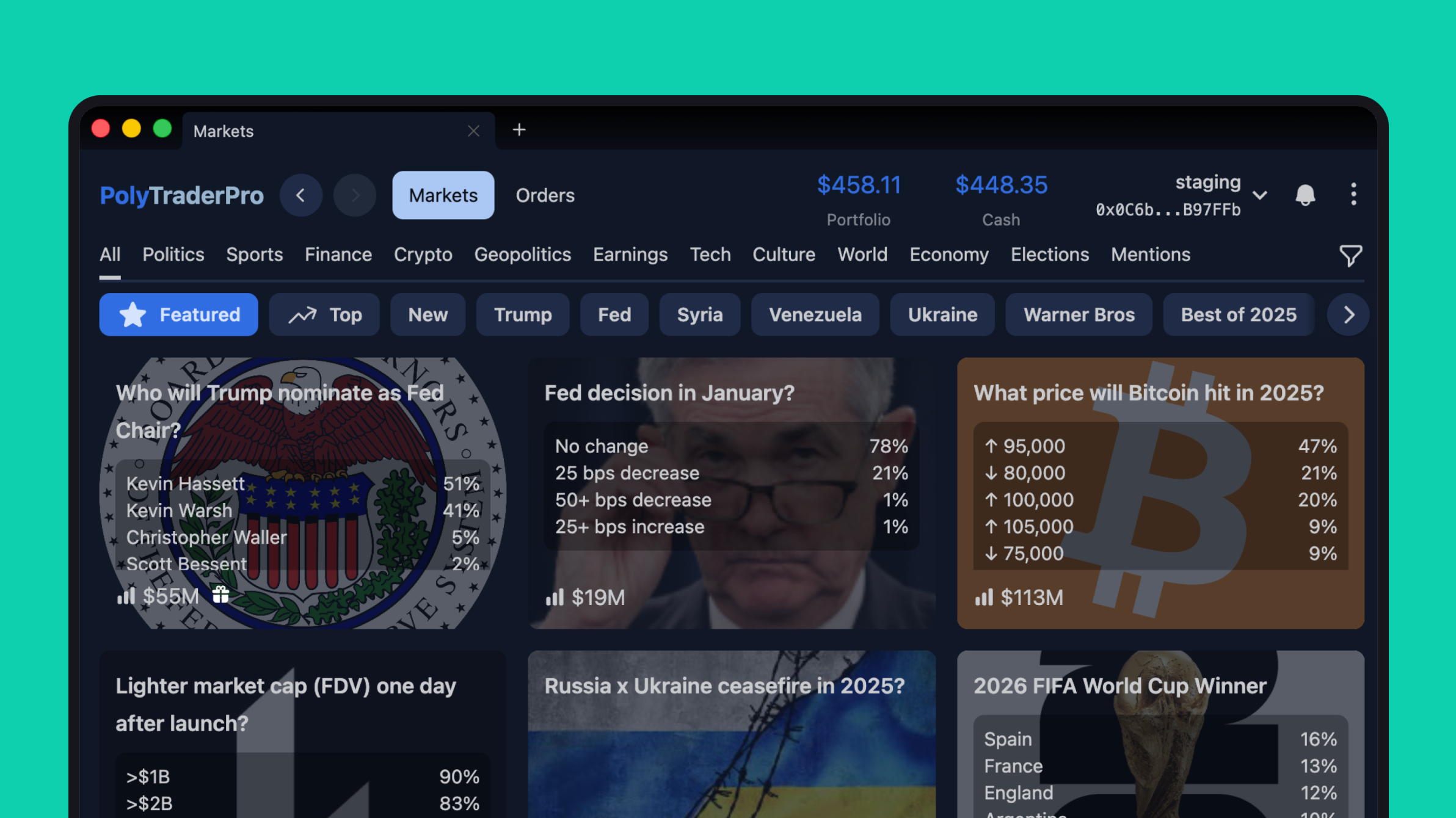
PolytraderPro: From MVP to Top-3 Polymarket Trading App (Fintech/Blockchain, USA)
A professional trader with over $2M in profit from Polymarket needed better tools than the platform’s web interface could offer. He partnered with Uinno to build PolytraderPro — a desktop trading application that now ranks in the top 3 for Polymarket trading, processes roughly $4M in weekly volume, and executes trades 5x faster than the web interface.
The technical challenges included building a Chrome-like tab system where each tab is isolated but shares real-time trade data, integrating with Polymarket’s undocumented APIs, and shipping across macOS, Windows, and Linux from a single codebase using Electron. The team achieved 3x faster development by using Tailwind CSS for UI instead of hiring platform-specific designers.
Lesson: An MVP built on a real user’s workflow pain, with clear problem definition from day one, can reach market-leading position even against better-funded competitors. PolytraderPro is what Step 1 of this guide looks like in practice.
Healthcare AI Co-pilot: Speech-to-Text for Clinicians (Healthtech, Australia)
A serial entrepreneur approached Uinno with a concept for an AI-powered co-pilot that converts patient-clinician conversations into structured clinical notes, reducing administrative burden for healthcare professionals. The mission was speed: get a working prototype in front of real clinicians fast enough to validate the concept before the competitive window closed.
Uinno delivered a working prototype within one month that demonstrated its value in an actual healthcare environment. The team built a modular architecture that did not depend on a single AI model, allowing rapid substitution if any provider’s quality dropped or pricing changed, a real risk in the AI landscape. Immediately after the MVP launch, the startup secured 10 paying customers, validating the founder’s concept and funding the transition into full product development.
Lesson: In AI-powered MVPs, modular architecture is an insurance. The speed from idea to first paying customer (under two months) came from a discovery-first approach and a team that knew where AI helps and where it creates risk.
Your next read: Top 10 MVP Development Companies
Conclusion
MVP development for startups is a discipline of choosing what not to build. The teams that win pick the smallest artifact that tests their riskiest assumption, lock scope, validate with 50–500 users, and graduate cleanly to v1 once the data clears the threshold. AI tools speed up the build for the work AI is good at and slow it down for the work it is not.
The cost tiers for minimum viable product development services split cleanly between $1K+ prototypes, $15K–30K custom MVPs, and $15K–50K+ AI-powered MVPs. The most important budget line item in every project is the $3K–8K discovery sprint that prevents the $50K rework. Learn more about Uinno’s discovery phase service that helps technical and non-technical founders build a product development roadmap that saves thousands in the future.
Reach out to see how Uinno's experience in mvp development can cut months off your development roadmap.
.png)
.png)